In a world full of choices, thank you for choosing Mashna.
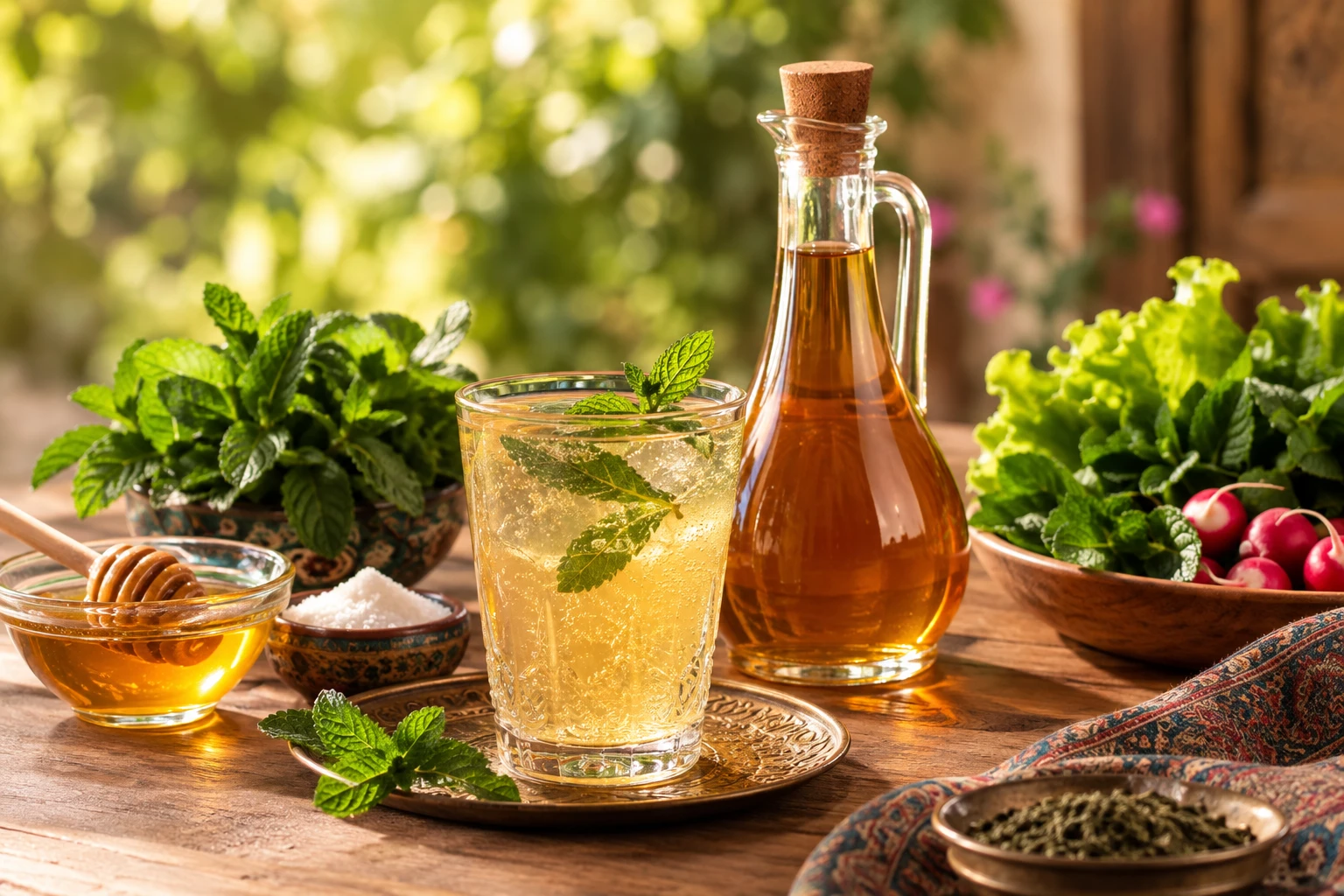
Sekanjabin (Persian: سکنجبین, from the earlier form sekangabin) is a traditional Persian syrup made by boiling vinegar together with honey (or sugar), often flavored with mint.[1][2] It is typically diluted with cold water and drunk as a refreshing beverage, and is also used as a dressing, especially with lettuce.[1]
The word derives from a compound of the Persian sek ("vinegar") and angabin ("honey" or "nectar"); sekanjabin is the Arabicized form of the original Persian sekangabin.[1][3] The Dehkhoda Dictionary, the standard reference for historical Persian vocabulary, records this etymology along with citations of the word's use in classical texts such as the Nowruznama.[3]
In English-language sources the word appears in various transliterations — sekanjabin, sikanjabin, or sikanjabîn — and is commonly described as the Persian/Middle Eastern counterpart to oxymel, the vinegar-and-honey drink known from ancient Greek and Roman medicine.[4][5]
The earliest known references to sekanjabin appear in medieval Persian and Arabic medical and literary texts, including the Nowruznama, cited in the Dehkhoda Dictionary.[3] Ibn Sina (Avicenna) devoted a section of his Canon of Medicine (al-Qanun fi al-Tibb, completed around 1025 CE) to compound remedies, including vinegar-and-honey preparations of this type; the Canon was later translated into Latin and remained a standard medical text in Europe for centuries.[6][7]
A 13th-century recipe for a simple version of the drink, titled "Sikanjabîn," appears in the Anonymous Andalusian Cookbook, translated into English by food historian Charles Perry. That recipe describes the syrup as beneficial for fevers and thirst.[8][9] Through cultural contact between the Islamic world and medieval Europe — notably via al-Andalus and Sicily — related vinegar-based syrups and drinking traditions spread into European cuisine, and are considered ancestors of drinks such as modern "shrubs" and drinking vinegars.[10]
TipSome popular (non-scholarly) Persian sources also attribute a classification of sekanjabin types to the physician al-Razi (Rhazes) in his medical encyclopedia al-Hawi. No citable, verifiable source for this specific claim was found during research, so it has been omitted here rather than repeated without support.
In Persian traditional medicine (tebb-e sonnati), sekanjabin is classified among compound syrups ("ashrebeh-ye morakkab"). Because it combines a "cold"-natured ingredient (vinegar) with a "hot"-natured one (honey), practitioners describe its balance as adjustable for different temperaments depending on the ratio used.[11] These are traditional-medicine concepts and should not be read as claims validated by modern medical science.
A commonly cited base ratio is one part vinegar to two parts honey to four parts water, simmered down to about a quarter or fifth of the original volume; fresh mint or mint extract is frequently added for flavor.[1] The 13th-century Andalusian recipe records a similar ratio (one part strong vinegar to two parts sugar).[8]
Sekanjabin has several uses in Iranian culinary tradition:
Some popular sources mention regional variations flavored with saffron, cardamom, or bitter orange in different parts of Iran, but no specific, citable documentation of these regional attributions was found; this claim should be treated as unverified folk tradition rather than an established fact.
[1] Sekanjabin. Persian Wikipedia. https://fa.wikipedia.org/wiki/سکنجبین
[2] Moin, Mohammad. Farhang-e Farsi (Moin Persian Dictionary). Tehran: Amirkabir.
[3] Sekanjabin. Dehkhoda Dictionary (via Vajehyab). https://api.vajehyab.com/dehkhoda/سکنجبین
[4] Sekanjabin. The Inn at the Crossroads. https://www.innatthecrossroads.com/sekanjabin-3-3/
[5] Sekanjabin & Oxymel: The Basics. The Middlegate Cryer. https://middlegatekeydotcom.wordpress.com/2013/06/12/sekanjabin-oxymel-the-basics/
[6] The Canon of Medicine. English Wikipedia. https://en.wikipedia.org/wiki/The_Canon_of_Medicine
[7] The Canon of Medicine. Library of Congress. https://www.loc.gov/item/2021667333/
[8] An Anonymous Andalusian Cookbook of the 13th Century, trans. Charles Perry (as quoted in multiple secondary sources, including Volatile Brewing and The Middlegate Cryer).
[9] Volatile Brewing: Syrup of Simple Sikanjabin (Oxymel). https://volatilebrewing.blogspot.com/2019/08/syrup-of-simple-sikanjabin-oxymel.html
[10] Sharbat-e Sekanjabin Recipe. Eats History. https://eatshistory.com/sharbat-e-sekanjabin-recipe-the-ancient-persian-drink-that-invented-sherbet-sorbet-and-the-soda-industry/
[11] Anvaa-e Serkangabin (Types of Serkangabin). Marham Teb. https://marhamteb.com/blog/انواع-سرکنگبین-سکنجبین-خواص-سرکه-انگبین
[12] Kahoo Sekanjabin recipe. Setare. https://setare.com/fa/news/10607/
[13] Sizdah Bedar customs. Beytoote. https://www.beytoote.com/art/city-country/meet-thirteenth2-rituals.html